
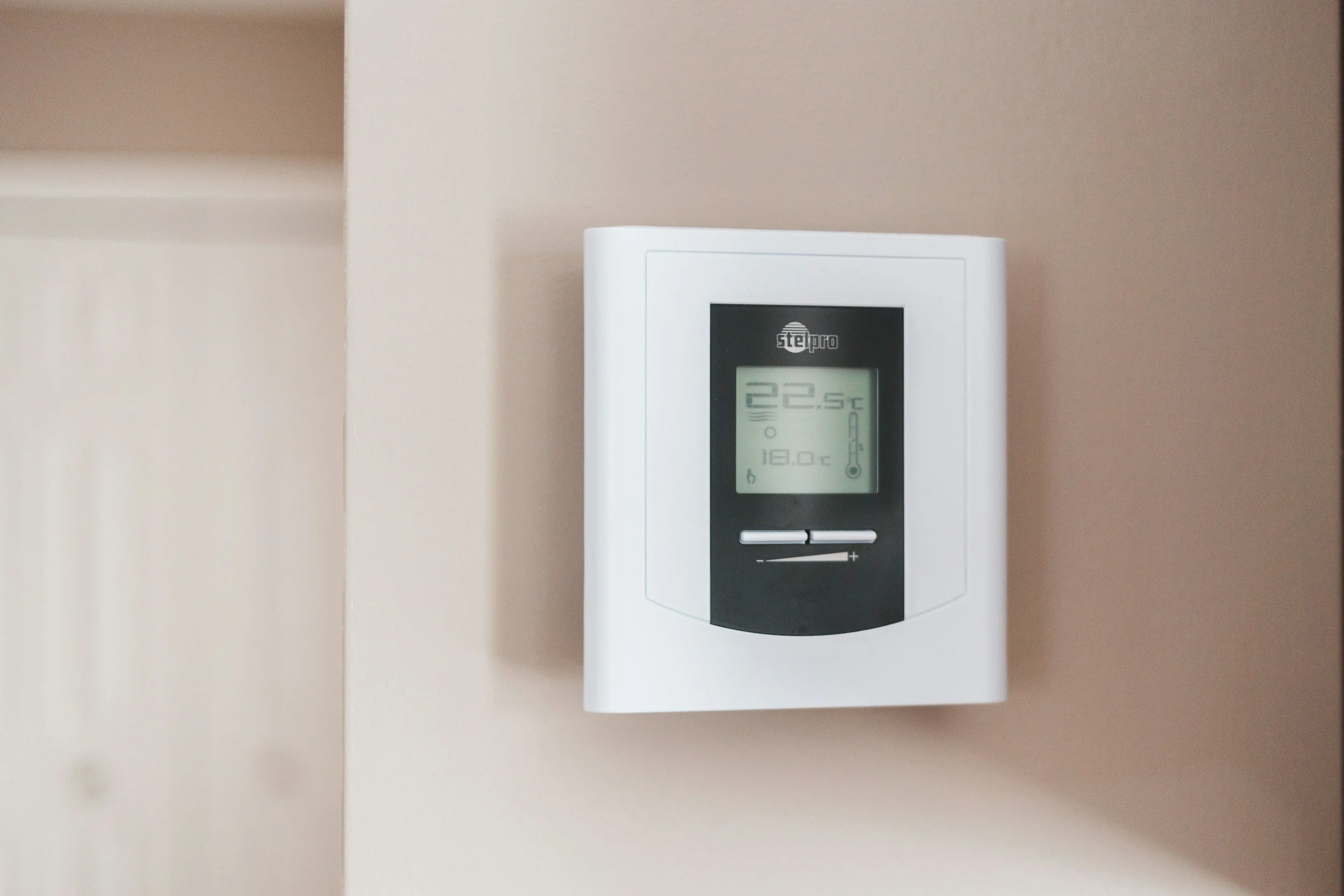
If your thermostat isn't working, start with the batteries, the breaker and the settings. Those are quick to check and often the whole fix. If the screen is blank with fresh batteries, it's set right and the system still won't respond, the thermostat or its wiring has likely failed. On most homes, replacing a failed thermostat makes more sense than repairing it, but a loose wire or a tripped float switch can look exactly like a dead thermostat. That's worth ruling out first.
Here is how to tell which situation you're in, and what to watch for before you swap one yourself.
Quick checks first
Batteries. A blank or flickering screen usually means dead batteries. Even thermostats wired to the system often have backup batteries that cause odd behavior when they're low.
Mode and setpoint. Set it to Heat, with the temperature a few degrees above the room. On a smart thermostat, check for schedules, "eco" or "away" modes, and app updates that changed settings.
The breaker and furnace switch. Many thermostats get their power from the furnace. If the furnace is off, the thermostat can go dark too.
Location. A thermostat in direct sun, over a lamp, or near a drafty door will read the wrong temperature and run the system at odd times.
If those check out, take the cover off and look. Dust and a loose wire are both common and easy to spot.
Signs the thermostat itself is the problem
The screen stays blank with fresh batteries and the system has power.
The temperature it shows is way off from a separate thermometer in the same spot.
The system won't turn on, or won't turn off, no matter what you set.
It clicks but nothing happens at the furnace or AC.
Settings reset on their own or the schedule won't save.
It's an old mechanical or mercury thermostat and the heating and cooling cycles feel uneven.
When it isn't the thermostat
Sometimes a "broken" thermostat is fine and the problem is somewhere else. The thermostat is just the messenger.
A tripped float switch. If your AC or high-efficiency furnace has a clogged condensate drain, a safety switch cuts power and the thermostat may go blank. Look for water in the drain pan.
A blown fuse on the control board. A shorted thermostat wire can blow a small fuse at the furnace and kill power to the thermostat.
A wiring problem. A broken or loose wire between the thermostat and the furnace, sometimes chewed or pinched in the attic.
The furnace or AC itself. If the thermostat is calling for heat and the furnace doesn't respond, the problem is at the furnace. Our post on a furnace that won't turn on covers that side.
Replacing a thermostat when the real problem is a clogged drain or a blown fuse just costs you a thermostat. A technician can test the wires at the furnace in a few minutes and tell you which it is. If you'd rather not guess, book a visit and we'll check the whole circuit from the wall to the unit.
Repair or replace?
Thermostats aren't really repaired the way a furnace is. A "repair" usually means fixing a loose wire, cleaning contacts, or resetting it. If the thermostat itself has failed, you replace it.
Replace it when:
It's dead with good power and batteries.
It reads the temperature wrong and recalibrating doesn't fix it.
It's more than about 10 years old and acting up.
It's an old mercury thermostat. Those contain mercury and need proper disposal, not the trash.
You've replaced your heating or AC system and the old thermostat can't run its features, like two-stage heating or a variable-speed blower.
What to know before you swap one yourself
Swapping a basic thermostat is a reasonable DIY job for some homeowners. A few things trip people up:
The C-wire. Many smart thermostats need a constant power wire (a "C" wire). Older homes often don't have one run to the wall, and workarounds can cause the thermostat to drain or the system to short cycle.
Heat pumps. Heat pump systems use different wiring than a gas furnace with AC, including a reversing valve wire and auxiliary heat. A wrong connection can leave you with no heat or with expensive backup heat running all the time. Many Dallas-Frisco homes have heat pumps, so check yours before you buy.
Compatibility. Two-stage and variable-speed systems need a thermostat that supports them, or you lose the comfort and efficiency you paid for.
Power off first. Shut off the breaker or furnace switch before you touch the wires. A shorted wire can blow the control board fuse.
If any of that sounds unfamiliar, have it installed. It's a short visit, and the tech can confirm the system runs through a full heating and cooling cycle before leaving.
Need a hand?
Whether the thermostat is dead or the problem is hiding somewhere else, we'll find it, tell you straight what's wrong, and give you a written price before we start.
Schedule a thermostat or heating visit or call (469) 285-4457. One family-owned crew handles your heating and cooling, based right here in Frisco.
Frequently asked questions
How do I know if my thermostat is bad?
A blank screen with fresh batteries and power, a temperature reading that's far off, or a system that won't respond to any setting all point to a bad thermostat. Rule out a tripped breaker, a float switch and loose wires first.
Why is my thermostat blank?
Usually dead batteries. It can also mean the furnace is off at its power switch, a breaker tripped, a safety float switch shut the system down because of a clogged drain, or a fuse blew on the furnace control board.
How long do thermostats last?
Most last around 10 years, sometimes longer. Smart thermostats can need replacing sooner if the manufacturer stops supporting the software.
Can I replace my thermostat myself?
On a simple system, many homeowners can. Heat pumps, two-stage systems and smart thermostats that need a C-wire are where DIY installs go wrong. Turn the power off before touching any wires.
Will a smart thermostat lower my energy bills?
It can, mostly by making it easy to set back the temperature when you're asleep or away. The savings depend on how you set it up and how you lived with the old one.